

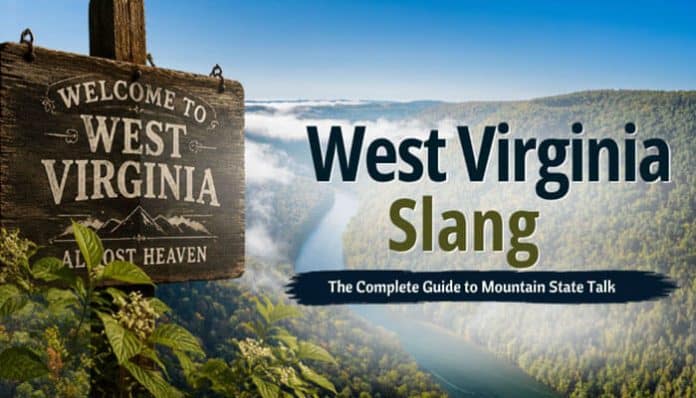

If you’ve ever visited West Virginia, you probably noticed something right away: People there talk a little differently. And we mean that in the best possible way. West Virginia slang is one of the most colorful, expressive, and deeply rooted forms of American regional speech you’ll ever come across. It’s not just funny phrases; it’s a whole way of seeing the world, shaped by mountains, coal mines, creeks, and tight-knit communities that go back hundreds of years.
West Virginia sits right in the heart of Appalachia, and the language there reflects that. The West Virginia slang you’ll hear in Morgantown or Charleston has Scottish-Irish roots, Native American influences, and old English words that most of the country stopped using long ago. It’s like a living museum of language, and once you start picking it up, you’ll find yourself using it too, even if you’re from somewhere completely different.
In this guide, we’re going to break down the most popular West Virginia slang words and phrases, explain what they mean, show you how to use them, and give you a real feel for the mountain state’s one-of-a-kind culture.
What Makes West Virginia Slang Unique?
Before we dive into the words themselves, let’s understand why West Virginia slang sounds the way it does.
West Virginia became its own state during the Civil War in 1863, splitting from Virginia. The people who settled in these mountains were largely Scots-Irish immigrants who brought their own old-world expressions with them. Add in Native American place names, African American vernacular from nearby regions, and the isolation that mountain geography creates, and you’ve got a dialect unlike anything else in America.
Here are a few things that make West Virginia slang stand out:
- Old English preserved: Some WV words go back to 16th-century English that died out everywhere else
- Appalachian vowel shifts: Words sound different because of how vowels are pronounced
- Coal mining vocabulary: The mining industry created its own layer of slang
- Strong community identity: People use these words with pride because they tie them to home
The Most Common West Virginia Slang Words
Everyday Words You’ll Hear All the Time
| Slang Word/Phrase | What It Means | Example Sentence |
| Holler | A small valley between hills | “He lives up in the holler past the church.” |
| Yonder | Over there/in that direction | “The store’s just yonder down the road.” |
| Reckon | Think/suppose/believe | “I reckon it’s gonna rain tonight.” |
| Fixing to | About to do something | “I’m fixing to head down to the store.” |
| Bless your heart | Can be sweet or sarcastic | “Bless your heart, you tried so hard.” |
| Directly | In a little while/soon | “I’ll be there directly.” |
| Might could | Maybe, might be able to | “I might could help you with that tomorrow.” |
| Crick | A small creek or stream | “The kids are playing down at the crick.” |
| Airish | Chilly, a bit cold outside | “Better grab a jacket, it’s airish out.” |
| Yins / You’uns | You all/you guys | “Are yins coming to the cookout?” |
West Virginia Slang for People and Relationships
One of the most charming parts of West Virginia slang is how people talk about each other. Mountain State folks have a rich vocabulary for relationships, personality types, and community roles.
- “Youngins”: Children or young people. “The youngins are already in bed.”
- “Old-timer”: An elderly person, usually said with deep respect. “Ask the old-timer, he knows every trail on that mountain.”
- “Britches”: Pants or trousers. “He came to church in his good britches.”
- “Neighbor-friend”: A neighbor who is also a close friend. More than just a neighbor, it means real community.
- “Kin”: Family members, relatives. “Half the town is my kin.”
- “Haint”: A ghost or spirit. “Don’t go in that old house, folks say it’s full of haints.”
West Virginia Slang for Food and Cooking
Food has its own language in West Virginia, and if you don’t know the WV slang for food, you might get confused at a family dinner.
| Poke sallet | A wild green plant (pokeweed) that’s cooked and eaten |
| Leather britches | Dried green beans strung up and preserved |
| Soup beans | Pinto beans cooked low and slow are a staple dish |
| Cornpone | Cornbread made without milk or eggs |
| Kilt lettuce | Fresh lettuce wilted with hot bacon grease poured on top |
| Ramps | Wild onions with a very strong smell, foraged in spring |
| Pawpaw | A native fruit that tastes like a mix of banana and mango |
| Shucky beans | Another name for leather britches / dried beans |
Tip: If someone invites you to “soup beans and cornbread,” say yes. You won’t regret it.
West Virginia Slang for Places and Directions
Giving directions in West Virginia has its own style. Don’t expect “turn left on Main Street. “Expect something more like this:
- “Up the holler”: Deeper into a small valley, away from town
- “Down the road a piece”: Not too far away, but not super close either
- “Over the ridge”: On the other side of a hill or mountain
- “Back in the hills”: Remote, rural, away from civilization
- “The Bottom”: Low-lying land near a river or creek, often where farms were
- “The head of the holler”: The very end of a small valley, where the road usually stops
- These aren’t vague: If you live in West Virginia, you always know exactly where someone means.
West Virginia Slang for Emotions and Reactions
West Virginia slang has some great ways to describe feelings that regular English just doesn’t capture the same way:
- “All tore up”: Very upset, emotionally distraught. “She was all tore up when she heard the news.”
- “Give out”: Exhausted, completely worn out. “My legs are giving out from hiking that ridge.”
- “Right smart”: Quite a lot. “That cost a right smart of money.”
- “Cattywampus”: Crooked, out of alignment, lopsided. “That picture frame is hanging all cattywampus.”
- “Ill”: Not sick, but in a bad mood, grumpy. “Don’t bother him, he’s been ill all day.”
- “Tickled”: Amused or delighted. “I was tickled pink when I saw the baby.”
- “Plumb”: Completely, totally, absolutely. “I’m plumb wore out.”
Unique West Virginia Phrases You Won’t Hear Anywhere Else
These longer West Virginia slang phrases are full sentences (or near-sentences) that carry a world of meaning:
1. “It’s coming up a cloud”: A storm is on its way.
2. “I’m not studying you”: I’m not paying attention to you / I don’t care what you’re doing.
3. “He doesn’t amount to a hill of beans”: That person has no value or reliability.
4. “She’s madder than a wet hen”: She is extremely angry.
5. “That’s a fine how-do-you-do”: Said when something goes wrong in a surprising way.
6. “Slicker than owl grease”: Very slippery, or very smooth/clever.
7. “Ugly as homemade sin”: Very unattractive (said playfully).
8. “I’d ruther”: I would rather (prefer). “I’d rather stay home tonight.”
West Virginia Slang from the Coal Mining Era
Coal mining is central to West Virginia’s identity, and it left a lasting mark on the local language. Some West Virginia slang words came straight from the mines:
| Mining Slang | Meaning |
| Company store | The store owned by the coal company, where miners were forced to shop |
| Scrip | Fake currency paid by coal companies instead of real money |
| Slate dump | A pile of leftover rock and debris from a mine |
| Gob pile | Another term for a mining waste heap |
| Red dog | Burned-out, reddish mine waste that was used to surface roads |
| Tipple | The structure where coal is processed and loaded onto trains |
These words are still used today in areas with mining history, and understanding them helps you understand West Virginia’s past.
How West Virginia Slang Sounds: Pronunciation Tips
Reading West Virginia slang is one thing; hearing it is another. Here are some quick pronunciation patterns to help you understand what you’re hearing:
- “Pin” and “pen” sound the same; this is called the “pin-pen merger”
- “Fire” sounds like “far,” one syllable instead of two
- “Tire” sounds like “tar”
- “Wash” is often pronounced “warsh”
- “Hollow” (the landform) is almost always said as “holler”
- “Creek” becomes “crick”
- “Window” might sound like “winder”
- “Hundred” might sound like “hunnerd”
These aren’t mistakes; they’re consistent, rule-based features of the Appalachian dialect. Linguists study them seriously.
Is West Virginia Slang Dying Out?
This is a real concern among linguists and West Virginia locals alike. With TV, the internet, and younger generations moving to cities, some traditional West Virginia slang words are being used less often.
However, there’s also a strong revival movement:
- Local writers and poets are using the WV dialect in their work to preserve it
- Social media accounts dedicated to Appalachian culture are growing
- University programs in West Virginia study and document the dialect
- Pride in Appalachian identity is growing among young West Virginians who want to reclaim their heritage
- Music, especially bluegrass and country from WV, keeps the language alive
So while some words are fading, the spirit of West Virginia slang isn’t going anywhere. If anything, more people outside the state are becoming curious about it.
West Virginia Slang Glossary (A to Z)
Here’s a fast-reference list of West Virginia slang words and phrases to bookmark:
| A–F | Meaning |
| Airish | Chilly outside |
| All tore up | Very upset |
| Bless your heart | Sweet or sarcastic compliment |
| Britches | Pants |
| Cattywampus | Crooked, out of whack |
| Crick | Small stream |
| Directly | Soon, in a little while |
| Fixing to | About to |
| G–M | Meaning |
| Give out | Exhausted |
| Haint | A ghost |
| Holler | A small valley |
| Ill | Grumpy or bad-tempered |
| Kin | Family/relatives |
| Might could | Might be able to |
| Mind | To pay attention or obey |
| N–Y | Meaning |
| Old-timer | Respected elderly person |
| Plumb | Completely, totally |
| Ramps | Wild spring onions |
| Reckon | Think, suppose |
| Right smart | Quite a lot |
| Tickled | Amused or happy |
| Yins / You’uns | You all, you guys |
| Yonder | Over there |
| Youngins | Children |
Fun Facts About West Virginia Language and Culture
West Virginia is the only U.S. state that is entirely within the Appalachian region
- The state motto, “Montani Semper Liberi” (Mountaineers Are Always Free), reflects the fierce independence also seen in the language
- The Hatfield-McCoy feud, one of America’s most famous family feuds, happened in West Virginia. Both families spoke in heavy Appalachian dialect
- WV native Gram Parsons (country music legend) helped spread Appalachian music to the world
- The word “holler” appears in place names across the state. There are hundreds of named hollers in WV
- West Virginia University linguists have documented over 500 unique dialect features in the state’s speech
Why Learning West Virginia Slang Matters
Understanding West Virginia slang isn’t just about language; it’s about respect and connection. When you know what someone means when they say “I’ll be there directly” or “she’s all tore up,” you’re not just translating words. You’re connecting with a culture that values family, land, hard work, and real talk.
West Virginia has often been misrepresented in the media and pop culture. Learning the actual language, how real people actually talk, helps break down stereotypes and builds genuine appreciation for one of America’s most unique regions.
Whether you’re a traveler, a student, a writer, or just someone who loves words, West Virginia slang offers a window into a world that is rich, deep, and absolutely worth knowing.
Conclusion
West Virginia slang is so much more than a list of funny words. It’s a living, breathing piece of American history. From “holler” to “fixing to,” from soup beans to ramps, the language of the Mountain State reflects centuries of culture, survival, community, and pride.
The next time someone tells you to look “yonder down the road a piece,” you’ll know exactly what they mean, and maybe you’ll smile, because you’re in on it now. West Virginia’s people have held onto their language the same way they’ve held onto their mountains: with both hands and a whole lot of heart.
If you found this guide helpful, share it with someone who loves American dialects or plans to visit West Virginia. And if you’re a West Virginian reading this, we reckon you might be able to add a few words we missed. We’d be tickled to hear them.
West Virginia Slang FAQs
1. What is West Virginia slang?
West Virginia slang refers to the regional vocabulary and expressions used in the Mountain State, shaped by Appalachian culture, Scots-Irish heritage, and historical isolation. Words like “holler,” “reckon,” and “fixing to” reflect a unique dialect that blends old English influences with local cultural evolution.
2. Why does West Virginia have a unique dialect?
West Virginia’s dialect developed due to geographic isolation in the Appalachian Mountains and early settlement by Scots-Irish immigrants. Limited outside influence preserved older English expressions, while coal mining culture and rural living added new regional slang over time.
3. What does “holler” mean in West Virginia slang?
In West Virginia slang, “holler” refers to a small, narrow valley between mountains where communities are often built. It comes from the word “hollow” but evolved in Appalachian pronunciation. It is still commonly used in rural directions and place descriptions today.
4. Is West Virginia slang part of the Appalachian dialect?
Yes, West Virginia slang is a major part of the broader Appalachian English dialect. It shares features such as vowel shifts, unique grammar structures, and preserved Old English words found across the Appalachian region of the United States.
5. Is West Virginia slang still used today?
Yes, West Virginia slang is still actively used, especially in rural areas and among older generations. However, modernization and media exposure have reduced everyday usage among younger people, although cultural revival efforts are helping preserve the dialect.
6. What are some common West Virginia slang words?
Some of the most common West Virginia slang words include:
- “Reckon” (think or suppose)
- “Fixing to” (about to do something)
- “Yonder” (over there)
- “Crick” (small creek)
- “Plumb” (completely)
These expressions are still widely used in rural and cultural communities.
7. Why is West Virginia slang important to preserve?
West Virginia slang is an important part of Appalachian cultural identity. It preserves historical language patterns, reflects community values, and represents centuries of heritage. Linguists and cultural researchers study it to understand the evolution of American regional languages better.
